People often ask the hypothetical of what sorts of behavior we consider normal today that people in the far future will regard as barbaric or bizarre. Our prison system is probably near the top of that list, for a variety of reasons. Not least of which is the sheer size of the prison population these days due to the war on drugs.
Even more significant is the widespread societal belief that prison experience should be brutal punishment and torture, with no concern for justice, fairness, or humaneness. Prison rape is a punch-line, it's not even on the radar as a political issue.
The public acknowledges, accepts, and approves of prison experiences as not merely pragmatic methods of keeping some folks separate from public society, and especially not as rehabilitory, but as retributive, vengeful, and arbitrary. These are the basest and most despicable sentiments when it comes to issues of criminal justice, but they rule the day in the 21st century as much as they ever did in the middle ages or even in the stone age.
This is easily one of the most significant issues of our time, as significant and important as the Cold War in the 20th century or the struggle over the abolition of slavery in the 19th.
> "Our prison system is probably near the top of that list,"
If by "our" you mean "the US" then I'm already of the mind that it's bizarre and barbaric and I doubt I'm alone.
In many ways it strikes me as suffering from problems similar to those in our older (now largely dismantled) system of insane asylums.
Both sought to address a very serious problem, for which we only have flawed solutions to choose from. And while we don't have proven-better alternatives for many of the problems that arise [1], it -- as a whole -- is progressing to a place where the system has been corrupted into a larger problem than the one it's trying to address.
[1] Though when we have for-profit industry lobbying legislators based purely on their profit motive, it's foolish not to say there are proven-better alternatives to many of the problems. To say nothing of the prison-rape culture and our societal response to it.
> And while we don't have proven-better alternatives for many of the problems that arise
Oh please. The US has a recidivism rate within 3 years of 67.5%. Norway has a recidivism rate of 20% within 2 years. There are proven-better alternatives, but your society has decided not to implement them.
You can't compare recidivism rates between a 300M nation of immigrants a 5M nation with an extremely homogenous culture. The US has social problems that are worse than Norway's worst nightmares. Prisons are just the tip of the iceberg.
You can, however, compare to other anglo-centric melting-pot countries, and the US experience is still vastly worse. And no matter which way you carve it, with the rest of the western world having an incarceration rate between 70 and 150/100k, the US is clearly out of order with a rate of 750.
In any case, your handwaving away of "we have bad social problems" is missing the point. Norway tries to fix them, using rehabilitation in its prisons as one example. The US tries to ignore them, and uses prisons as punishment. It's a point of philosophy. No-one expects that the US recidivism rate would drop to Norway's levels should the focus shift to a Norway-style penal system, but they do expect it would still drop markedly.
compare to other anglo-centric melting-pot countries
There are no comparable countries. The US is the absolute worst in the West. But just you watch. The UK and Sweden and Norway are importing diversity at an alarming rate. Eventually, their prisons will turn hard, but not through policy. Policy follows reality.
California's excessive solitary confinement policies strongly belie its left-leaning government. Get a steady dose of murder/rape/robbery and that's what happens.
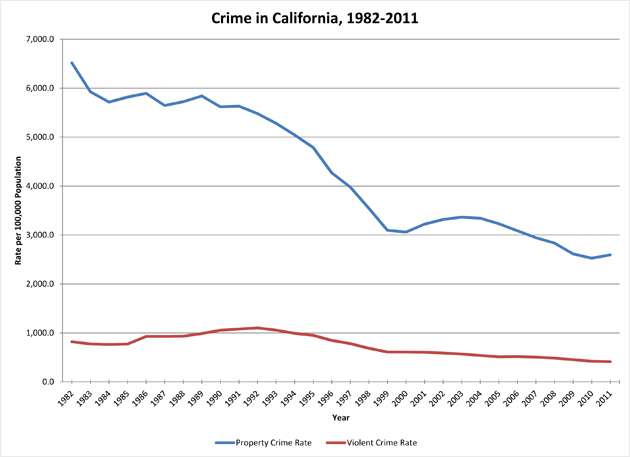
And prisons aren't punishment. Only victims want to punish criminals. Everyone else just wants kept far away from criminals, and if that means putting rotten people in cages, fine. You can see the effect here:
Do you have any evidence that immigration or diversity is the cause of social strife? The U.S. prison population is hugely disproportionately African American. The U.S. has not had a large influx of immigrants from Africa in more than a century (for the obvious reason). Our prisoners are by and large not immigrants, or the children of immigrants, or the grandchildren of immigrants. They're the homegrown domestic American poor.
Most immigration to the US consists of Hispanics who are relatively mild, only committing about 2x the crimes of the rest of population. I was referring to countries like Sweden which are hell-bent on importing Muslims and Somalians and the like.
As to social strife, this is a standard book, even though written by a leftist, who tries to make the best of it.
Immigrants were five times more likely to commit sex crimes
I absolutely do not believe that number. It is almost certainly more like 10 or 15 times. The Swedish government is a pure head-in-ass creature, and almost certainly bending the statistics.
I've actually been waiting for the Stockholm riots to settle down a little before I analyzed them, but the results I'm expecting is a disproportionate amount of immigrant participants.
You don't need to wait. As someone living in Stockholm I can tell you that there is not a shadow of a doubt that the riots have a majority of immigrant participants.
The reason is that these riots are highly localized to poor areas where the population is almost exclusively immigrant, being clumped together by Swedish immigration policies. (Map: http://cdn.thinglink.me/api/image/394110718607097857/1024/10...) While international media might have given you an image of a Stockholm of fire, most Stockholmers have not seen a trace of the riots.
With large amounts of youth failing basic school, being unemployed, and lacking parents and role models who have jobs and have integrated into the Swedish society. Riots are almost bound to happen.
I'm not entirely sure what you mean, since immigrants would tend to have a lower income level,
But I think my answer is yes, if you factor out middle-to-high income rioters, you would still see a disproportionate representation of immigrants to natives.
My theory is fairly simple: it's about incomplete integration. If natives fail to identify immigrants as accepted natives, there will be conflicts that regularly break out into anything from racial profiling to riots (such as the famous LA riots) to civil wars to secessions (such as South Sudan).
I could also be completely crazy in seeing this pattern, though; I'm not an expert in this area by any means.
Some of this has to do with African-Americans who have been living in poverty for generations stretching all the way back to slavery -- a situation which doesn't exist in Iceland.
It also has to do with the US economic policies which promote the flight of low-skill jobs overseas. Not everyone has the intellectual ability to be a doctor or a web developer (especially given our dismal education system), and there are only a limited number of low-skill non-relocatable jobs like food service or retail. Things were much better for people with limited education when labor unions had a monopoly on many unskilled jobs and could set monopoly pricing on wages. Now, with tariffs and high shipping costs no longer keeping manufacturers from moving overseas, competition from workers in desperately poor countries is forcing wages downward; when the going rate for a given job falls below the US minimum wage, those jobs simply disappear from the US entirely.
Unfortunately, global corporations who benefit from the situation have too much influence over US politics, opponents of this aspect of the status quo are too disorganized, and the analysis I outlined above is not widely enough accepted for change to happen in the near term.
"nation of immigrants" - You know that kinda getting old.
We're all immigrants if you dig back far enough, but in reality if you were born and raised in a country, you are not an immigrant and within a couple of generations, there are likely to be no real residual effects.
There are exceptions to this rule which are related to inheritance and cabals of cultre but for the most part, immigration seems to be a net gain, it's a lack of social mobility that is causing problems.
Modern Europe immigration policy seem are a bit fucked up, but I imagine you can pretty well correlate education and welfare with crime stats, but beyond that, hardening your ordinary criminal doesn't seem to help anyone.
Some of what you mentioned here, if not most, seems specific to the USA, from my western European point of view. Do you know of any explanation for that?
Visibility for one. The French prison system is horrible, the British prison system is also pretty bad. Beyond that I'd have to blame the war on drugs and general societal attitudes. The general attitude seems to be that once you have been adjudicated a "bad guy" and are put into the prison population anything that happens to you is fair game.
The French prison system is severely underfunded leading to very poor living conditions, but there is none of this attitude that it's OK for people to be raped if they're criminals. The statistics for rape in US prisons are absolutely appalling; I have never seen such data for French prisons, but I would guess, or at least hope, that it is much less common.
Not only is the French prison system severely underfunded, as you say, but it has been consistently so for years, despite repeated warnings from the EU. This has been compounded by recent laws handing out longer prison sentences for more crimes (but obviously not following through with a matching increase in funding for the prison system).
As very few prisoners actually vote, this horrid blight on France's human rights track record isn't going to change in a hurry.
It's pretty easy to see that if there's not acceptance, there's at least almost complete apathy. There hasn't exactly been many widespread calls for better conditions in our prisons, and in day to day life, I've never heard anyone suggest it.
Joking about things that are in despicable in reality is commonplace. The TV show "Family Guy" features a pedophile as a main character. Do you think this means the audience or producers feel this is normal and acceptable?
I would say that the majority don't care, and depending on how you phrase the question, you could get them to swing either way. The problem is that in public discourse, prison rape is seen as a punchline, not a blight.
> People often ask the hypothetical of what sorts of behavior we consider normal today that people in the far future will regard as barbaric or bizarre. Our prison system is probably near the top of that list, for a variety of reasons. Not least of which is the sheer size of the prison population these days due to the war on drugs.
I agree except that I don't consider our prison and drug policies "normal" or acceptable. And a significant amount of people don't consider them normal. I think, for more in the spirit of that question, it's interesting to consider what 95+% consider normal that in the future 95+% will consider barbaric. Something like that.
I agree completely. I believe that this is a cultural and political problem.
I cant imagine a politician saying that he will fund prisons get any votes whatsoever. It would be suicide. And whatever fruits would come from such measure , he would never see, and the population as a whole is likely to ignore.
This is the kind of problem that comes from Democracy, unfortunately. Not prisons, but the inherent inhability to address a real, provable issue that falls flat on public opinion.
I also believe this is an economic policy issue as well. The problem is exacerbated by increasingly unequal living conditions. Its no secret that crime and socio-economic status is highly correlated.
The above statements really make the problem a lot larger, however i believe this wont be fixed until something changes in the above, because convicts are the most politically and economically weak part of society.
If the prisons were focused on fixing the root problem in the criminals, as if they were some sort of refuge for edification, conditioning and correction then a large body of the homeless would commit a strategic crime in order to get there so they can at least get three meals and an opportunity to move up in the world from rock-bottom.
Like slavery in the 18th century, prisons are a necessary evil to punish people who do not deserve rehabilitation, correction or edification. Conditions have to be bad enough so that a large segment of the rock-bottom citizens don't commit crime just to get some hope. Therefore the conditions of prison have to be a few steps less desirable than being homeless, penniless, cloth less, hungry and with no hope of getting out of it.
It's my belief that jails are full of criminals because we don't understand the mental illnesses that brought them there. If we can do whole-brain simulation, emulation, and detection in a client, I think studying the body of brains in jail vs the body of brains outside jail will reveal some remarkable findings. It could be their ethical systems were coaxed into the off position, and we may be able to detect this before a person commits crime. Saying: "You better get your ethical centers back on-line, or we'll have to put you under increased surveillance".
> If the prisons were focused on fixing the root problem in the criminals, as if they were some sort of refuge for edification, conditioning and correction then a large body of the homeless would commit a strategic crime in order to get there so they can at least get three meals and an opportunity to move up in the world from rock-bottom.
1. Prisons as correctional center far outweighs some homeless guy pick-pocketing so that he doesn't have to die tired, hungry, cold, alone on pavement.
2. A homeless guy not dying on the pavement is a benefit in itself.
> prisons are a necessary evil to punish people who do not deserve rehabilitation, correction or edification.
People go to prison for a variety of reasons. Not paying your parking ticket or possessing 5gm of Marijuana do not qualify as "do not deserve rehabilitation".
> Like slavery in the 18th century, prisons are a necessary evil
Slavery was a necessary evil?
> It's my belief that jails are full of criminals because we don't understand the mental illnesses that brought them there.
1. You can believe whatever you want.
2. Stretch the definition of law and everybody is a criminal.
3. The spectrum of things you can go to jail for is so wide the belief that all criminal brains are wired the same way has a low probability.
4. The belief that "criminals" deserve what they get is how all sorts of draconian laws come into being. When the govt. says it tortured a few alleged terrorists, and you stand on the sidelines and cheer, you don't realize you are being instrumental in your own destruction. Tomorrow it can be you getting water-boarded, and the rest of us "good citizens" will stand on the sidelines and cheer.
> The belief that "criminals" deserve what they get is how all sorts of draconian laws come into being. When the govt. says it tortured a few alleged terrorists, and you stand on the sidelines and cheer, you don't realize you are being instrumental in your own destruction. Tomorrow it can be you getting water-boarded, and the rest of us "good citizens" will stand on the sidelines and cheer.
    First they came for the communists,
    and I didn't speak out because I wasn't a communist.

    Then they came for the socialists,
    and I didn't speak out because I wasn't a socialist.

    Then they came for the trade unionists,
    and I didn't speak out because I wasn't a trade unionist.

    Then they came for me,
    and there was no one left to speak for me.
What about when the socioeconomic game is rigged against you and has been for most of the last 400 years of American history?
I mean, yeah, poverty is without question a factor--but stopping there feels disingenuous to me. Why are they poor? is then a relevant question, and I think that "because of the racism of old white men" is not the worst explanation I've heard.
OK, but then that's a different issue. It isn't racism in the criminal justice system, and it isn't the criminal justice system's failure. It's the failure of the rest of society.
And even if it is racism originally, it's plausible that it's "because of the racism of dead white men." Two centuries ago they kidnapped millions of Africans and brought them here as slaves. Then they were freed without anyone offering to return them to their original communities in Africa or providing them any resources here to raise successful children. The legacy of that is not going away any time soon even if racism today were totally eradicated, because even in a society with greater upward mobility than we have now, poor parents will always be more likely to have poor children than rich parents.
If what you say is true, then why is this not an explicit part of our criminal justice system? Why are there no laws and regulations which spell out the brutalities that prisoners should be exposed to? Why is the process not formalized, institutionalized, documented, and routine?
Why has there been no public campaign to repeal or modify the 8th amendment to the US constitution (banning cruel and unusual punishments)? Or to set new legal precedent in the UK to invalidate the equivalent protections in the English/British constitutions? If it is such a foundationally important part of a well-functioning society then why is it not being talked about and debated above board?
The law of the U.S. and other countries is full of such two-tiered systems, i.e. what is written and what is well-known, e.g. "Don't ask, don't tell". All human society works that way; we learn it at home and at school.
There's a guy currently in solitary confinement serving time for felony hacking. The hack? Executing GETs against a public API. He got a 41-month sentence for that.
I am hoping this is satire and you aren't seriously arguing that "prisons have to be barbaric otherwise the homeless and the destitute would use them to avoid starvation".
> people who do not deserve rehabilitation, correction or edification
Wow. I know it's a matter of philosophical debate whether such people actually exist[0]. But it's a matter of wilful ignorance to pretend that anything but a tiny minority of the US prison population falls under that category.
I think they don't. There's people that would be a really bad idea to ever let back in to society (say, a Breivik) but for a lot better reasons than "does not deserve rehabilitation/edification". Then there's people for whom rehabilitation is pointless because they're so mentally deranged they're not going to get better. Obviously such cases are the minority and very rare.
Also, did you consider to think: If your homeless prefer prison, that might not be because your prisons are too pleasant, but rather how you treat your homeless? Why are they left without "an opportunity to move up in the world from rock-bottom"? It's a ridiculous argument, "we can't treat group X humanely because then group Y who we also don't give a chance will want it too"--what?!
It's those lowest rungs that a society is judged by, you know. Whether the average American has a better life means absolutely zilch as long as you leave your schizophrenics begging and mumbling in the streets, and keep people in solitary the way this article describes.
>Conditions have to be bad enough so that a large segment of the rock-bottom citizens don't commit crime just to get some hope.
The blatantly obvious alternative to this is for the government to provide adequate food assistance and homeless shelters such that you can get the free meals and roof without committing a crime first, in which case there would be no incentive to do this whatsoever.
I'm kind of glad that this is your perception. This should be everyone's perception of prison. You should have an extreme necessity to keep your ass out of prison. You should be scared absolutely shitless of prison, so much that you play exactly by the rules to keep yourself from ever going there. Our prison system does a pretty good job at driving this perception home.
Prison is not a rehabilitation center. If it were just a means of keeping folks separate from society, I know plenty of unmotivated individuals that would love to sit around with a bunch of other lazy-asses and be fed 3 meals a day. For free. Don't you?
Prison has to be scary. It has to strike one as the number one place that you do not want to go. It's the other ultimate consequence, along side of death. I can't imagine this world if it wasn't.
I don't think anyone thinks the deterrent effect of prisons are ineffective. However, the at-risk populations who most often end up in prison are bad at weighing these deterrents, especially before they go there. Another factor is the quality of deterrence: the point is not to arbitrarily and randomly ruin peoples' lives. You want a high ratio of crime reduction to damage. A good penal system does this and bad penal system works the other way around. A lot of science suggests that the life-ruining factor is a significant counter-effect to the original goal of reducing crime and increasing quality of life in our democracy.
That's me being polite. If I was less polite, I would say how much I hate your ignorant, lazy self-righteousness and how this despicable and inhuman attitude is a major factor in how our system destroys people with little to no scientific justification.
No it doesn't. The problem with chest-thumping-ego-driven-bullshit like this is that it is very fact-adverse and causes more problems than it solves. Your type of prison is nothing more than a gang training camp.
TLDR version: "the punishment is being locked up; we do not add to the suffering."
Google translate is decent at times, funny at other times (the vulture entering the scene is a translation of the prison director's surname), and woefully incorrect at others ("e.g. The IBT'ers still put their helmets on and not ask first what's going on" should be "don't put their helmets on but ask first what's going on"), but I think the message comes across.
Two things to add:
1) the "for life system" (rightfully, IMO) is under scrutiny from the EU because, effectively, nobody ever is pardoned.
> Prison has to be scary. It has to strike one as the number one place that you do not want to go. It's the other ultimate consequence, along side of death. I can't imagine this world if it wasn't.
You cannot make that assumption, there can be other factors that lower the rate to 1/10th and without those it could actually be 10x just because "prison isn't scary". I'm not taking any sides but you can't make that jump without controlling every other variable.
A very Hobbesian view of society, I see. Not one I subscribe to, nor one that, from my experience, is reflective of reality.
Prison experiences in the US are pretty horrific in the norm, and yet there are more people in prison than ever (as a percentage of the population), and many of them are there due to fairly minor or victimless crimes. There is some sort of dissonance there, and I think it comes down to the fact that fear is not the sole or even necessarily the primary motivator for behavior on the boundary of the law.
Also, there are countries where prison is not scary, where the criminal justice system raises rehabilitation above other concerns, and such places (such as Canada and the scandinavian countries) are not the lawless hellholes your theory of human behavior would have them be.
Sidenote because I agree with the main thrust of your argument, but:
> A very Hobbesian view of society, I see.
Not at all. The central argument in Hobbes' Leviathan is that most people are basically decent and reasonable, but that we need a strong, consistent rule of law in which to relax our guard and build personal, civic and business relationships with each other in a positive sum game where everyone benefits.
It is the fear of violence and death in the absence of the rule of law that leads to the Hobbesian trap: a tragic situation in which someone who doesn't want trouble ends up pre-emptively raiding someone else who also doesn't want trouble, simply because they have no way to trust one other.
Western European prisons, Australian prisons, Japanese prisons and prisons in other civilized, well-developed, rich countries are much nicer to stay in than American prisons and still our criminal problem isn't nearly as large as yours.
I'm not the least bit afraid of going to prison here. Still I don't break the law, for reasons better than fear of prison.
On youtube there's a tv show "Australia's Hardest Prison", a max-security prison in WA. In it the warden is seen saying (paraphrased) "we try to do rehabilitation here, and the people you read in the newspapers calling for longer sentence simply don't understand prisons". There is also a grey-haired American prisoner who has been in several prisons in several countries. He has the opportunity to return to the US for imprisonment there, and he refuses, wanting to finish his life sentence in Aus because "it's... humane". Then you can click on any of the "America's hardest prisons" videos and they're all about using fear to keep you in line, overcrowding, so on and so forth. There's no overriding philosophy of embetterment, or if there is, it's merely lip-service.
On the subject of prison harshness I don't think holding up Japan as a model of care and compassion is a good idea (link is old but not much has changed, I hear).
> Prison has to be scary. It has to strike one as the number one place that you do not want to go. It's the other ultimate consequence, along side of death. I can't imagine this world if it wasn't.
Prison is not a deterrent. If it was, you would see prison population decline over time. Instead, it has grown quite significantly and in a racist way (black men are massively overrepresented and sent to prison).
Just because prison population is rising does not mean that people are choosing to go to prison. The criminal justice system is choosing to send more and more people to prison for offenses that would not have incurred prison time in the past.
More importantly, the people that do the Very Bad Things that we want prison to deter often do not think enough about their actions to consider the possible consequences, and also don't really think that it could happen to them.
When people don't even think consequences will ever apply to them, how can the consequence act as a deterrent?
What are the sources of these assertions? This seems like sheer speculation, or common-sensical reasoning -- do you know anyone from prison? Have you conducted some kind of psychological survey of prisoners?
I think it's likely this is not because of the prison as much as it is the laws which determine what crimes are punishable by prison sentences, and the people who enforce and judge on those laws.
This would be fine if many prisons were not privately owned entities and if most inmates were not overly sentenced for minor drug charges.
We also have a growing incarceration rate (U.S), which shows that prison does a pretty poor job of making people "scared absolutely shitless of prison so much that they play exactly by the rules" and don't forget, sometimes the rules are pretty ridiculous.
Also "...individuals that would love to sit around with a bunch of other lazy-asses and be fed 3 meals a day. For free." is already the reality of the situation in many cases.
It's not a choice between the scariest most brutal situation you can imagine or no prison at all. There are other options to make a better system. And in general, a society shouldn't have to be scared into "playing by the rules".
True, some institutions shouldn't be privatized at all even though it might look like it's cheaper or more efficient to do so.
It's not always about money, at least not here in Austria.
I'm glad we have a baseline level of wealth. Do we always need more? Trying to be better, faster, stronger? When do we stop? Does it make sense in the end? Is it even really guaranteed to be the most productive strategy?
Isn't the fact that I can walk through the most "sketchy" Vienna neighborhoods in the middle of the night worth quite a bit? Again I'm not talking about money here.
Obviously the thought of prison doesn't in fact stop people from breaking the rules. The prison population is in fact growing. Similarly many places have prisons that are very unlike the US prisons, and yet they have lower crime rates. So the evidence against the core of your argument is pretty strong.
At some point, when the punishment for minor offenses is extreme, the difference between minor offenses and major offenses gets very blurry. Extreme example: if stealing carries a punishment that is effectively the same as murder, the only logical thing to do when stealing is murder any potential witnesses. The US isn't quite this bad.
However, when the actual punishment for minor crime includes the concept of a felony record, it becomes much harder to differentiate between minor possession of drugs and say grand theft. They both carry felony record issues. That means the being convicted of either results in prison, exclusion from most of the work force for life, the inability to participate in a lot of "better yourself" programs (and really, people who messed up earlier in life should be encouraged to be in these!) and a host of other life long punishments. I understand this is a bit tangential to your point, but bear with me...
Now, when you look at the way the US justice system actually does things, you get this perception of arbitrariness or even randomness. The threat of prison is there, but there is no intuitive logic to how it works. Carrying some drugs will get you 20 guaranteed years in prison, while murdering someone will get you maybe 5, maybe 100. Raping someone will get you less time than "hacking". Racial discrepancies exist too in how prison is applied, as do wealth issues. There is parole/early release, and differences between judges and prosecutorial discretion further complicating the punishment question.
Whether or not there is good, deep, and sound defensible logic in how this works, the appearance is that there is no way of determining how you'll punished for what you're doing. As such, once the decision has been made to do something relatively harmless, the deterrent effect of prison no longer applies. The rational choice is "punishment, when it happens, could be anything", therefore the game is no about deciding actions based on punishment, it is deciding actions based on getting caught. Any action, no matter how severe, that lessens your chance of getting caught is better than a less severe action which doesn't modify or worsens the chance of conviction.
Basically my point is that when you want to use prisons to deter bad behavior, you better make it obvious that their application is something that can be reasoned about. As it stands, prison can't be included in any reasoning about consequences, except in an overly simplistic binary matter that has no effect at curbing any behavior once it is on the table.
> Obviously the thought of prison doesn't in fact stop people from breaking the rules
Speak for yourself. Articles like this one sure as fuck make me think twice about doing anything even remotely likely to get me into prison. Punishment as deterrence is a legitimate policy within reason.
That said, torturing someone with forced isolation until they are completely insane, especially if they are ever getting out, seems counterproductive.
[edit: re-read the post I'm replying to and I agree, random irrational punishment is a lousy deterrent. For deterrence to work the system has to be at least nominally fair, and punishment meted out needs to be proportional to the degree of misbehavior. That is clearly not the case with the US justice system, and as the article points out, inside the prison the rules are applied with astonishing caprice and unfairness.]
My two points would be that in the UK people as sent to Prison AS punishment, in the USA it seems they are sent there FOR punishment.
Also it's not the punishment that stops most people committing crimes, but the fear of getting caught. No matter how bad prison is, if we let people see such lawlessness in their communities that they feel they commit crime with impunity, then some will.
> I know plenty of unmotivated individuals that would love to sit around with a bunch of other lazy-asses and be fed 3 meals a day. For free. Don't you?
No. I know absolutely no people who would choose to be put in prison simply because they would be fed. I cannot imagine a wealthy society (and make no bones about it, our society is wealthy enough that people can be fed) which would permit that.
> It has to strike one as the number one place that you do not want to go. I can't imagine this world if it wasn't.
Try visiting Sweden some day. Or quite a few other places in the world -- almost any country other than the US, which is quite competitive for the world's worst prison system.
I've read (though I cannot find a link) of a homeless (or sick?) person who commited crimes because he felt prison's shelter + food was better than freezing/starving on the street. Reading the account, it was hard to consider than an irrational decision.
> No. I know absolutely no people who would choose to be put in prison simply because they would be fed. I cannot imagine a wealthy society (and make no bones about it, our society is wealthy enough that people can be fed) which would permit that.
Have you seen The Green Mile? I think that's the name of the movie, where the lead character contemplating committing a crime just so life would be easier again.
Some people do chose prison; or, enough of their friends are in prison that it's not actually seen as a 'bad thing' for them to be in there. Add to that how we as a society feel about people that have come from prison and are a felon; and sometimes, life may actually be easier for some people on the inside.
I think you're thinking of The Shawshank Redemption.
Also the character only says that because he's been in prison for most of his life and he's so old when he gets out that he doesn't know how to function outside of prison.
<_< you're right. It's been a long while since I've seen even a part of that movie. Honestly, I don't know if I've ever seen the whole movie; but, I do remember that part.
Upvoted to counter the ridiculous downvote legion. I fully disagree with your point, but it's a fair point worthy of HN, and I applaud you for uttering what is clearly a minority opinion here.
Advocating what amounts to rape and torture just because we don't break it into its components (it's tacitly accepted, after all) is utterly abhorrent and deserves every step closer to invisible that it's getting.
Soo, people who you disagree with should be stopped from spreading their opinions? Come on, it's not that extreme, he's supporting the status quo. It's not like he's saying that all <minority X> should be killed. For comparison's sake, I once wrote here that "the Israeli government are a bunch of nazis" (and I'm still ashamed of that), and I got fewer downvotes (which doesn't make any sense at all, it was a horrible and worthless thing to write). In fact, people who disagreed with me took on the discussion and I learned a lot. That's what HN should be about.
I really don't understand why supporting the current US prison system is an opinion so dangerous that it must be hidden from sight.
Also, if you would've carefully read his post, you'd have seen that he doesn't advocate rape and torture, but the perception of it. It's a subtle difference, but a significant one.
>Soo, people who you disagree with should be stopped from spreading their opinions?
Nobody's stopping anybody from spreading their opinion, last I checked. I said the downvotes were deserved.
Not only for being factually incorrect, ("Prison has to be scary", which is the whole premise of the post, is handily disproved by looking at some of the Nordic nations' systems), but for perpetuating the kind of culture that allows solitary confinement (i.e. psychological torture) and prison rape to be accepted by otherwise sane and caring people.
The culture of "whatever happens to guys in prison is their own fault" NEEDS to stop.
> Nobody's stopping anybody from spreading their opinion, last I checked. I said the downvotes were deserved.
directly contradicts
> [it] deserves every step closer to invisible that it's getting
from your previous comment.
Also, you know that downvoting something enough hides it from HN. On HN, a downvote doesn't mean "I disagree", because we have comments for that. A downvote means "this comment isn't HN-worthy".
As for the actual discussion topic, I mostly agree with you and I don't understand why you're discussing it with me. I'm defending another's right to disagree with you and me.
> The culture of "whatever happens to guys in prison is their own fault" NEEDS to stop.
I agree, but I'm appalled that you think you can enforce a culture change by hiding the opinions of people that don't want that culture change. You can't shove culture down people's throats.
Actually, it does. pg has said that it is fine to use this way.
I think it's stupid, and you'll see in my profile a screed against the braindead moderation style of HN and why I think it's bad. I don't particularly care anymore though - there is no interest from the admins in changing it, so it's pointless to try.
It's possible to disagree with an argument without losing respect for the person making it. You might, for instance, have a rare or specialized experience that would lead you to think differently from another person. Even if you know that person to be wrong, you wouldn't respond with a downvote. Not if their position was intelligent and stated in good faith. Reasonable people disagreeing, and all that.
And then there are the idiots. Here, the downvote is less about disagreement per se, and more about a response to thought that is generally stupid and awful. What it says is that your opinion is so unworthy of consideration that it's simply being removed from circulation.
The comment you're commenting about doesn't use either of these words. He (or she) merely says that "prisons should be scary" and "the current system does a good job of achieving that."
In fact, I would tend to agree with him: Prisons should be scary. If people have no reason to be scared of prisons, what keeps a huge number of people from just giving up on ever doing anything economically productive and instead just shoplift or burglarize whenever they want/need something and don't have enough money for it, because they know that once they're caught they can just take it easy and sit in jail playing video games all day? If that happens, who will grow and prepare all the food to feed these prisoners, and do the work to maintain the jail facilities (and the supply chain which produces the needed materials)?
A society that doesn't have a punishment that people are afraid of seems to me like it would be on a short road directly to a complete collapse of civilization.
The second point is right on the money as well: The current system does do a good job of being scary. I certainly don't want to go to jail, and I've made a habit of noting gray areas in the law where behavior I intuitively think of as "reasonable" is actually illegal, and how you should conduct yourself around law enforcement officials to minimize your chances of going to prison (in the US, you should never help them in any way, never lie to them or physically resist them in any way, refuse consent to all searches, and decline to speak with them unless you have the advice of a lawyer who represents you and will be present during the questioning.)
Neither he nor I say that rape and torture is the only possible way to make prisons scary. For me, being locked up for years without video games is scary enough by itself.
Downvoting on opinions you disagree with diminishes the value of HN, because then there will be ideas which may have merit, or lead to thoughtful insights, which no one will speak for fear of downvotes.
> I applaud you for uttering what is clearly a minority opinion here
Me too! I think HN can be too much of an echo chamber sometimes, especially when it comes to politics. (Whether articles like this one are HN-relevant material is questionable, but I've found the comments here to be much more well-reasoned than most of the political discourse I've seen on the Internet.)
In fact, I personally do my part to help this by occasionally playing devil's advocate -- saying things I don't necessarily believe, which I know will be controversial, risking downvotes solely for the sake of stimulating a good discussion.
People sometimes find it very difficult to agree to disagree, especially about highly controversial subjects like politics. This has a chilling effect even on me: I try very hard to keep this account separate from my real identity, so people whose opinion I care about won't take one of my devil's advocate comments out of context. (For that matter, I tend not to advertise my actual political views to people unless I know them well and think they will either agree with me, or are intellectually mature enough to accept that sometimes people acting in good faith can have different opinions than they do. And I think that I am so constituted that I would act in this way in the current US political environment no matter what my views actually were.)
I also upvote comments I disagree with, if they're sufficiently well-written and thought-provoking, especially if they seem to have been downvoted solely because people disagree with the opinion.
if this view was correct, then surely countries with even harsher penalties for breaking the law, such as even worse prisons or death, would have less crime than the united states, right?
While I disagree with the parent, this is not a solid argument. It's entirely plausible, without further data introduced into the conversation, that (say) Americans have a higher penchant for crime, and so our prisons need to be correspondingly harsher, and simply aren't harsher enough.
> You should be scared absolutely shitless of prison
Or from another point of view what makes prison less scary than the outside world? Everyone knows prison is unpleasant yet that doesn't appear to stop the increasing numbers each year.
> Our prison system does a pretty good job at driving this perception home.
If this was a performance review they should be fired.
How about all the innocent people who end up in prison? A small fraction of those people are exonerated. Imagine if you were sent to prison because of the color of your skin, you were falsely accused, or just because of plain corruption? Scrapcode, you better pray that you don't ever end up like one of those unfortunate people. Our justice system is broken and far from being able to be fixed. Justice is a joke, and so far it is truly blind....


Even more significant is the widespread societal belief that prison experience should be brutal punishment and torture, with no concern for justice, fairness, or humaneness. Prison rape is a punch-line, it's not even on the radar as a political issue.
The public acknowledges, accepts, and approves of prison experiences as not merely pragmatic methods of keeping some folks separate from public society, and especially not as rehabilitory, but as retributive, vengeful, and arbitrary. These are the basest and most despicable sentiments when it comes to issues of criminal justice, but they rule the day in the 21st century as much as they ever did in the middle ages or even in the stone age.
This is easily one of the most significant issues of our time, as significant and important as the Cold War in the 20th century or the struggle over the abolition of slavery in the 19th.