For a long time, the US had the money to build things, use them, let them slowly deteriorate, and then abandon them.
It was cheaper to simply let things fall into disrepair, and build shiny new buildings and developments further away from the city center. Rinse and repeat. This is why a lot of inner ring suburbs are filled with strip malls that can't maintain their parking lots, don't have the residential density to support nearby businesses, etc.
It's kind of an interesting development pattern that's been pervasive since the 1950s, and some towns and cities are trying to reverse it with infill.
It wasn't cheaper for any physical reason. It was cheaper because we regulated it that way on purpose.
We've intentionally made it unconscionably expensive to bring anything not built to current standard back into service even in a limited capacity (e.g. sublet a factory into smaller space) because we have because this stuff is mostly the purview of local governments who seem to optimize for some middle-ish ground path of "what makes Karen screech least" and "what makes the professional developers who know everyone in government happiest". There's various exemptions for small residential stuff, but at scale it's all just crap that tends toward "don't allow anything that isn't a new build or a high dollar revitalization project"
Seriously, go to your local zoning board, planning board, etc public facing meetings sometime. The shit they put people who just want to spend huge sums of money to develop stuff, run businesses etc, in your city/town through is beyond the pale. And then some "professional" shows up with a BigCo packet about "here's why our toxic waste dump on the ground floor with a strip club on the top floor can go beside the school" and they can't approve it fast enough. You'll be looking for bulldozers on facebook marketplace before the meeting is half over.
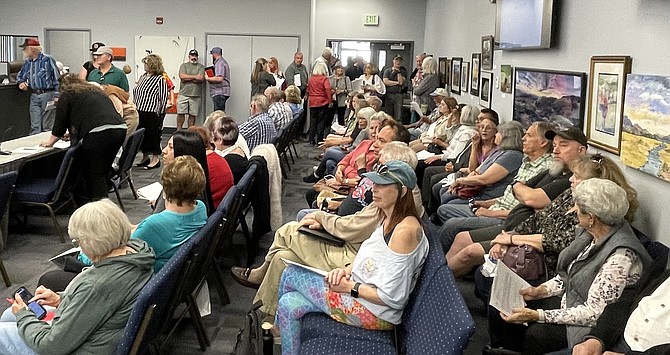
You don't even have to listen to the meeting, just take a look around. Here's one at Carson City[]. Notice something about the demographics? None of those people look like young family in need of their first home or condo. It's people old enough that already have a place, bought during the days while the getting was still good, and are looking to secure their property values. Maybe a few of them had bad luck or had a nasty divorce and lost their house and have no real estate now, but that's unlikely to be the majority of them.
There's almost no overlap between people on and with the means and time to go to planning and zoning meanings and the people who have the greatest marginal utility lowering the bar to owning a business or a home.
Depends on the meeting type. If you go to whichever one involves the relevant committee or board extracting expensive concessions from mundane businesses you're gonna see more younger people because first time business owners tend to be the ones who get screwed the most because they blunder right into all the traps the system has prepositioned for such people.
I watched two brothers in their 30s who'd bought a 12-unit (they lived in it) go rounds with the city over all manner of petty bullshit that can be construed as a legitimate concern on paper but really isn't if you look at the totality of the situation. Ultimately they hired the law firm which was owned by a lifelong developer who was the head of the equivalent board in the next town over (i.e. someone who knew people) and suddenly none of those things were problems anymore.
Why did it fund sprawl? Why didn't anyone choose to develop density on existing sites? We built that stuff just fine from 1870 through the 1940s. What changed? Surely it wasn't the proliferation of government regulation of the development process (and the financials thereof) that caused developers to optimize for greenfield sprawl crap that could most cheaply check the boxes, get the cheap money, get the approvals, be compliant, etc, etc.
> Surely it wasn't the proliferation of government regulation of the development process (and the financials thereof) that caused developers to optimize for greenfield sprawl crap that could most cheaply check the boxes, get the cheap money, get the approvals, be compliant, etc, etc.
I'm sure white flight was a component, as well as subsidizing the auto manufacturing industry and a car centric planning model with federally funded highways.
A large problem in speed limit setting is that 85th percentile is used many times for setting the speed limit and other factors are ignored or aren't weighted as heavily.
It's a very fuzzy practice, and I think as we continue towards an automated driving world, we need to be more critical of how speed limits are set.
Using the 85th percentile as a means to determine speed limits ends up with 15% of all drivers exceeding the speed limit, or worse, more drivers exceed the speed limit than those original 15% because they know consequences may be rare.
An argument I've heard is that by legalizing betting, it can be more easily monitored with regulation and reduce the amount of black market betting. People still bet when it's illegal, it just becomes harder to track, which makes it easier for gamblers to interfere with outcomes without detection.
It sounds kind of similar to the legalization of certain recreational drugs. For example, alcohol prohibition resulted in a massive black market with organized criminal gangs, and many places realized it's better to regulate it rather than prohibit it.
I think for gambling, we need better regulations, and the Australian government seems to think so too.
Almost nobody was betting in the black market before the legalization. Sure you obviously had some people, but friction was big enough where it was not worth it. Right now, there isn’t a single game where people are talking about the bets they made in NA.
Nothing should be black and white. Even for alcohol and drug abuse, we should look at each and evaluate.
I don't know about Australia but there was an enormous amount of black market sports gambling in the USA before it was widely legalized. People who were unaware of this were just oblivious or led very sheltered lives. Broad legalization may have been a net negative for society but it's a complex issue.
define enormous? before it was legalized I knew one mate that was a gambler. I don’t have a friend anymore who does not sports gamble, hardly have relatives that don’t sports gamble. die-hard fans of teams now don’t give a hoot if the team wins (especially in the regular season)… not saying this is not a complicated issue but to say market was enormous is very much removed from reality
Yep it's hard to build a large liquid market for both sides of the bet without a central platform being legal. Look at polymarket as another example of things that people wouldn't bet on if a (legal in some countries) platform didn't exist.
Very few people gambled illegally. Putting some gangster out of business (Lol if you actually believe that) at the cost of addicting the entire working class to throwing away their money is bad math!
Illegal gambling has been rife for a very long time - the bookie down the pub taking bets on horses, games, whatever
Add to that that the Costigan Commission (1984) and the Fitzgerald Inquiry (1989) proved that illegal gambling was the foundational "river of gold" for organised crime in Australia.
But your original claim was 'very few gambled illegally' which the historical record contradicts.
The Costigan and Fitzgerald inquiries showed illegal gambling wasn't just widespread - the profits funded other organised crime including the heroin trade.
We can debate whether legalisation was net positive without rewriting that history.
> The race track, it appears, is a great meeting place for criminals. The
Costigan Royal Commission (Australia 1984), the Connor Inquiry (Victoria 1983), the Moffit Royal Commission (New South Wales 1974) and the Fitzgerald Inquiry (Queensland 1989) revealed that a vast network of SP bookmakers exists throughout Australia. They found the monetary flow in the industry huge, and as such has the potential to finance many other illegal activities.
> Mr Justice Moffit warned that there was evidence to indicate that SP syndicates were in contact with major heroin smugglers and domestic drug distributors (New South Wales 1974).
> Connor estimated that the annual turnover for SP bookmaking was $1800 million in New South Wales and $1000 million in Victoria. Connor has said of illegal
bookmaking:
>> Illegal bookmaking is a multimillion dollar industry run by people who can get up to forty or fifty telephones and who, if their telephones are closed
down, can get them in new premises a week later. Illegal bookmakers prosper, making millions of illegal dollars, simply because they do not pay income tax or betting taxes
(Victoria 1983a, vol. 2, ch. 14).[0]
McMillen, J. (1996). "Gambling Cultures: Studies in History and Interpretation."
This academic study explains that SP bookmaking was a "submerged" culture. It operated through "runners" in pubs and massive illegal telephone exchanges. If you weren't a "punter" or part of that specific working-class pub culture, the infrastructure was invisible by design to avoid police detection. (unfortunately I cannot link you to a direct copy - but https://www.taylorfrancis.com/books/edit/10.4324/97802039935... )
Dont be dense, we are talking about "very few" in the context of draft kings which prints more money in 1 week than black market gambling has in years. The turnover in legal sports gambling in america is over 100b a year, this is larger than the gdp of most countries.
my grandma is not going to be looking for a black market bookie. some percentage of people will be no matter what though if you make penalties really severe you will significantly thin out this crowd.
without gambling though, pat mahomes would be making less money that I am making…
> without gambling though, pat mahomes would be making less money that I am making…
It's not like he was broke when it was just beer and crypto ads. He made 10 million dollars his rookie year in the NFL before SCOTUS federally legalized gambling.
When I worked for Oracle in 2015 during my co-op there, IDC was generally just another office. NetSuite may be their focus, but I think they generally cover almost all Oracle software.
Yup. If my gf is streaming something and an ad appears, I'll trigger the download for it during the first ad break, and then when the second ad breaks, it'll most likely be finished downloading and then we switch to JellyFin.
The only use we have for streaming apps is finding what we want to watch.
Yep, and that's already way more sophisticated than it needs to be. I no longer bother with the collecting aspect and just download everything on the fly, usually takes less than 5 minutes
This is great to hear, I've been wanting a flip phone for a while. GrapheneOS on a Moto Razr would actually be incredible. Thank you for all of your hard work and being active in this thread. I'm looking forward to getting my hands on a Motorola with GrapheneOS :)


It was cheaper to simply let things fall into disrepair, and build shiny new buildings and developments further away from the city center. Rinse and repeat. This is why a lot of inner ring suburbs are filled with strip malls that can't maintain their parking lots, don't have the residential density to support nearby businesses, etc.
It's kind of an interesting development pattern that's been pervasive since the 1950s, and some towns and cities are trying to reverse it with infill.
reply